


This is some text inside of a div block.
Getting Started with Dedoose
Review key features and terminology, data preparation tips, create a project and import data.
Learn More


Review key features and terminology, data preparation tips, create a project and import data.
Braun & Clarke's reflexive thematic analysis from familiarization to final write-up. Built into the platform researchers trust for qualitative and mixed methods work.
Braun & Clarke's six-phase reflexive thematic analysis, built into the qualitative research platform researchers have trusted for over two decades.
A qualitative method for identifying, analyzing, and reporting patterns of meaning within data — where the researcher's subjectivity is treated as a resource, not a source of bias.
The reflexive focus foregrounds three commitments: researcher reflexivity, interpretation, and theory. It is not a recipe and not a code-counting exercise. It is interpretive scholarship.
A method for identifying, analyzing, and reporting patterns of meaning within data — anchored by the researcher's active, reflexive engagement.
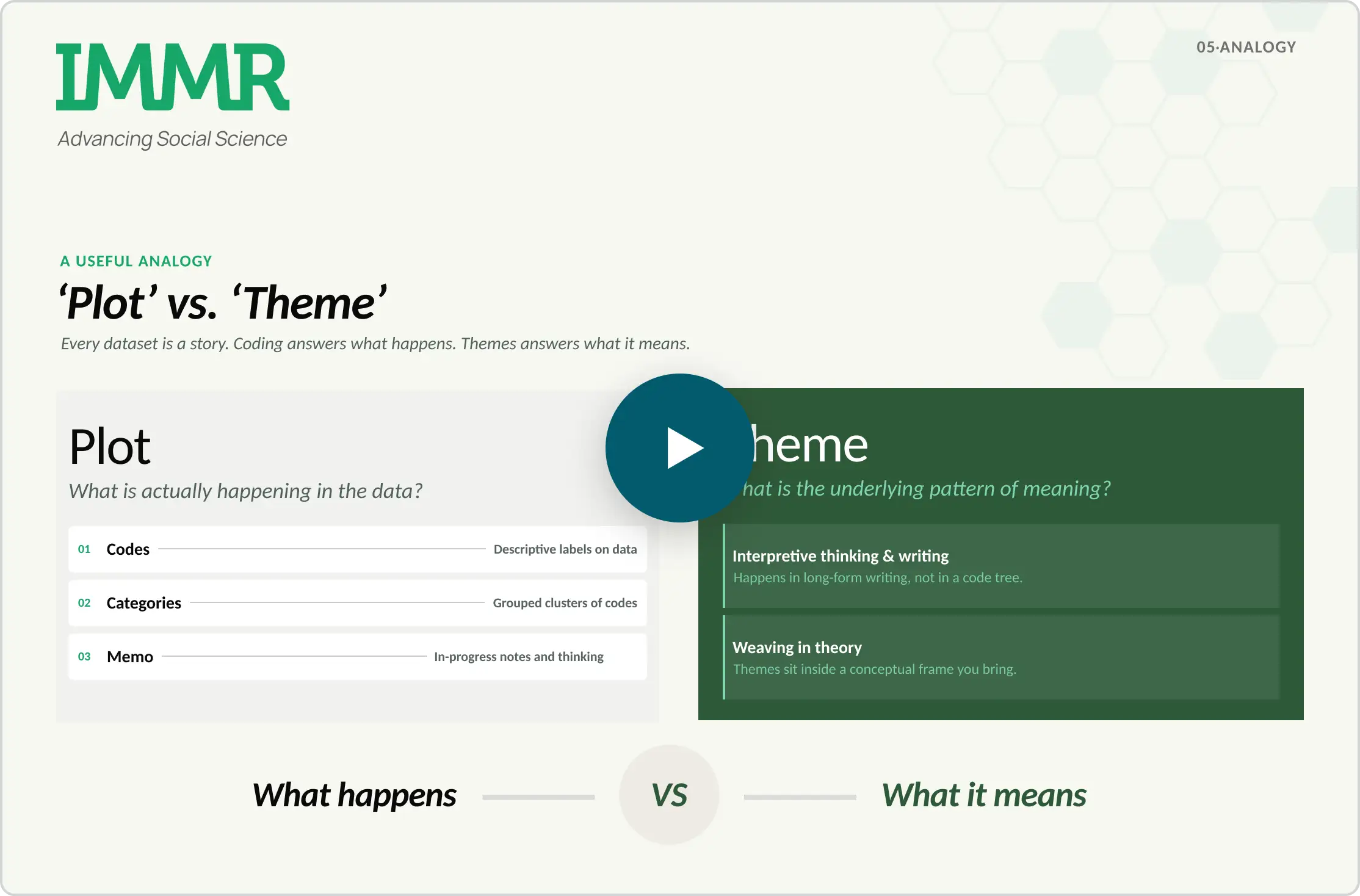
More qualitative papers stumble here than anywhere else. The labels look similar, but the analytic work is not.

A descriptive account organized by question, prompt, or topic. It reports the surface of the data.

A pattern of shared meaning anchored by a central organizing concept. It interprets what the data is doing.
If you have written about or follow narrative structure, you already know the difference. Plot is what happens. Theme is what it adds up to. The same distinction holds in qualitative analysis.

— Dr. Sara E. Grummert
A clear path through the method. Dedoose supports phases one through four. Phases five and six happen in writing and you should expect to move iteratively in and out of the platform as your themes take shape.
Upload transcripts, audio, video, and field notes. Highlight, excerpt, and code your data with a tight, distraction-free interface designed for sustained reading.
A hierarchical codebook with definitions, subcodes, and code categories for organization. Designed to grow and reorganize alongside your analytic thinking.
Create reflexive notes, draft candidate themes, and review memos linked directly to excerpts. Make your reflexivity visible from day one.
Visualize code overlap and co-occurrence to develop and refine themes. Export excerpts cleanly when you are ready to begin writing.

Track your positionality, assumptions, and shifts in interpretation alongside the coding itself.
Semantic codes capture the explicit content; latent codes capture implicit or conceptual meaning. You need both.
Themes are the last thing you commit to — not the first. Work from codes to categories to candidate themes.
Split, merge, cut, and rename themes once you return to the full dataset. This is normal, not a setback.
Export excerpts and memos. Move iteratively in and out as your themes develop and take shape.
Does it go beyond summarizing the data? Is your theoretical framework woven into the theme?
Even rigorous projects can go off track. Here are some common pitfalls to watch for and reminders to keep your analysis strong.

These are places where thematic analysis often goes wrong.
"Barriers to care" is a topic. "Care as negotiated trust" is a theme. If your theme could be a question in your interview guide, it isn't a theme yet.
Codes organize data so that themes can emerge. A paper whose results section is a list of codes has stopped at phase two.

These practices strengthen your analysis and your write—up.
The method's strength depends on making your positionality visible. Memo your reflexive thoughts as you code, create a structured memo format, and report it in your methods section.
Dedoose supports phases one through four. Phases five and six are writing, diagramming, and re-reading excerpts in context. The latter phases benefit from moving iteratively between the platform and your writing.
Dedoose is founded and run by active social scientists and PhDs—not software executives. The platform is shaped by the way qualitative work actually happens: iterative, interpretive, and grounded in the researcher's own thinking.
Multi-user access at no extra cost. Code together, memo together, build the analysis as a team.
Methods help from active researchers — not a generic ticketing queue. The team knows the method, not just the software.
A platform designed around the way qualitative analysis is actually done. No wasted clicks, no fighting the interface.
Annual or monthly — your choice. Pricing built for grants, dissertations, and research budgets that have to make sense.


