


My First Project Series
Access resources tailored to your learning style
Getting Started with Dedoose
Review key features and terminology, data preparation tips, create a project and import data.
Learn More


Review key features and terminology, data preparation tips, create a project and import data.
My First Project Series
Dr. Alan Santinele Martino (he/him) is an Associate Professor in the Community Rehabilitation and Disability Studies program in the Department of Community Health Sciences at the University of Calgary. His main research interests are in disability, gender and sexualities; feminist and critical disability studies theories; and qualitative and community-based research (particularly participatory and inclusive research methodologies). His work has been published in multiple journals, including, for example, Disability Studies Quarterly, Sexuality and Disability, and Sexualities, as well as edited volumes focused on disability and/or sexualities studies. He has guest-edited three special issues. He is the lead of the Disability & Sexuality Lab at the University of Calgary. In recognition of his research contributions, he was awarded the 2024 Early Investigator Award by the Canadian Sociological Association and the 2024 Early Career Award by the Sociology of Sexualities Section of the American Sociological Association.
Disability and sexuality continue to be treated as taboo topics across public discourse, academic research, and even within disability and social service sectors. Despite these persistence silences, disabled people have always found creative ways to express desire, cultivate intimacy, and claim space within sexual cultures. Over the last decade, digital platforms have become especially significant sites of for this work of exploration and self-representation.
One platform that has generated significant both fascination and controversy is OnlyFans. OnlyFans is a subscription-based platform best known for allowing creators to monetize sexually explicit content. While the platform has been widely discussed in relation to sex work, digital labor, and influencer culture, one group has been almost entirely absent from scholarly analysis: disabled content creators themselves.
Our project, conducted by me alongside undergraduate researchers Eleni Moumos and Rachell Trung, set out to explore one question that has received almost no scholarly attention: How are disabled people participating in OnlyFans as content creators, and what does this reveal about digital sexual labor and representation?
This was our first major project using Dedoose, and it quickly became clear that the platform would be to carrying out a rigorous and collaborative analysis of such sensitive material.
The intersection of disability and sexuality remains highly marginalized across academic research. Disabled people are frequently desexualized, infantilized, or framed through therapeutic and medicalized narratives that obscure their desires, pleasures, and erotic lives. At the same time, being a content creator on OnlyFans is sometimes mired in stigma, legal ambiguities, and moral anxieties.
Very little is known about how disabled creators navigate digital spaces like OnlyFans. The platform promises autonomy, flexibility, and self-representation, yet it also exposes creators to surveillance, harassment, and platform-based precarity. For disabled people—many of whom are excluded from traditional labor markets or forced into rigid benefit systems—these tensions can be especially pronounced.
We were particularly interested in questions such as:
Our aim was not to romanticize the platform, nor to dismiss its harms, but rather to document the complexity of disabled people’s participation in digital sexual economies.
Given the exploratory nature of the study, we turned to publicly available online content that allowed us to examine two parallel discourses:
Our final dataset included:
These sources offered very different vantage points. The Reddit material was especially powerful. Accounts were raw and candid. People with disabilities discussed their bodies, economic precarity, independence, vulnerability, and pride.
Working with this material required careful ethical consideration.
Working with online content that intersects disability and sexuality required significant reflexive engagement. Early in the project, our team made several decisions:
These discussions became a core pedagogical component of the project. As I mentored Eleni and Rachell through the ethical tensions of qualitative research, Dedoose provided a shared workspace where we could annotate concerns and flag sensitive sections for team discussion.
When we began, we knew that this project required methodological rigor but also flexibility. We were working across:
Dedoose’s collaborative environment made all of this possible.
1. Collaborative Coding in Real Time
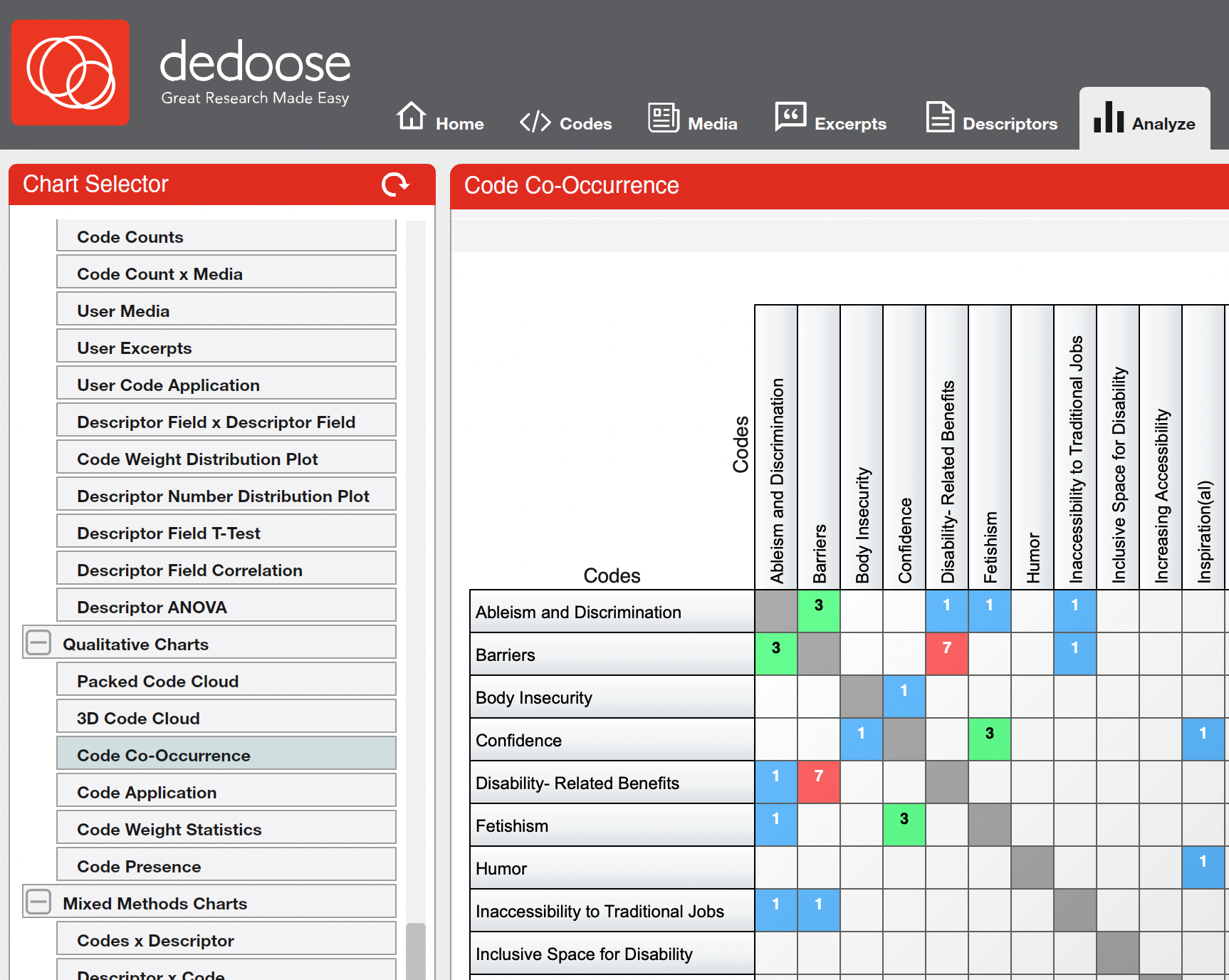
All three team members participated in code development and application. Dedoose’s visualizations allowed us to identify coding divergences and return to the data for deeper discussion rather than treating disagreement as error.
2. Tracking Theme Development
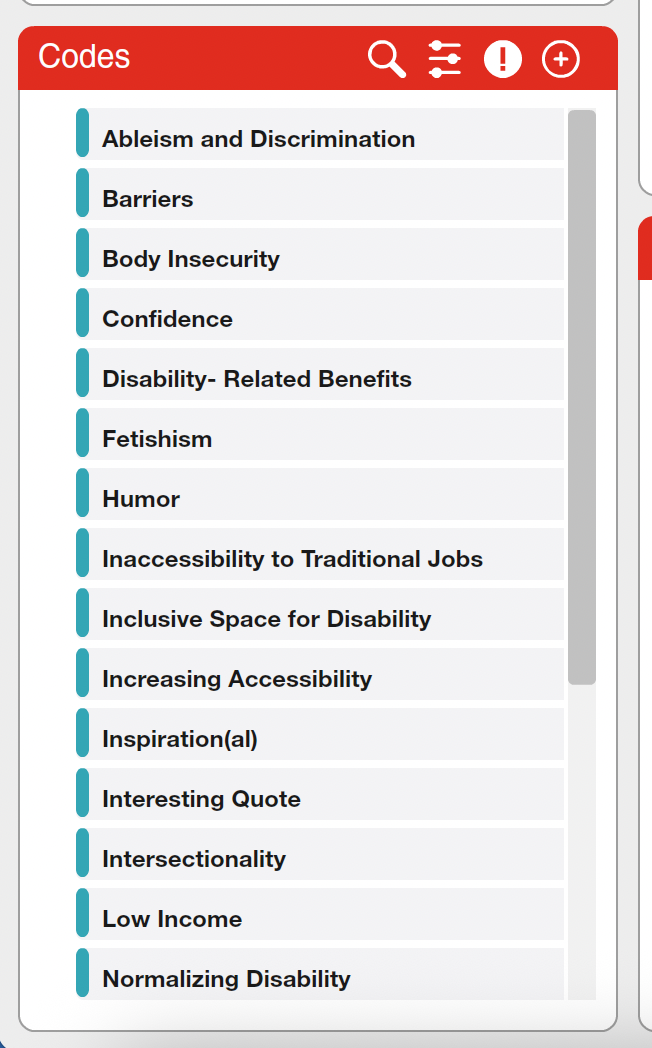
We began with inductive, descriptive codes and gradually refined them into more analytical categories. The drag-and-drop code tree allowed us to restructure our framework as our thinking evolved.
3. Reflexivity Built into the Workflow
Memos functioned as living documents where we logged interpretive tensions, positionality reflections, and ethical dilemmas: an essential practice for research on sexuality and disability.
4. Visualizing Relationships Across Data Types
Housing media articles and Reddit threads in a single analytic environment made it possible to trace sharp contrasts between how disabled creators represent themselves and how journalists represent them.
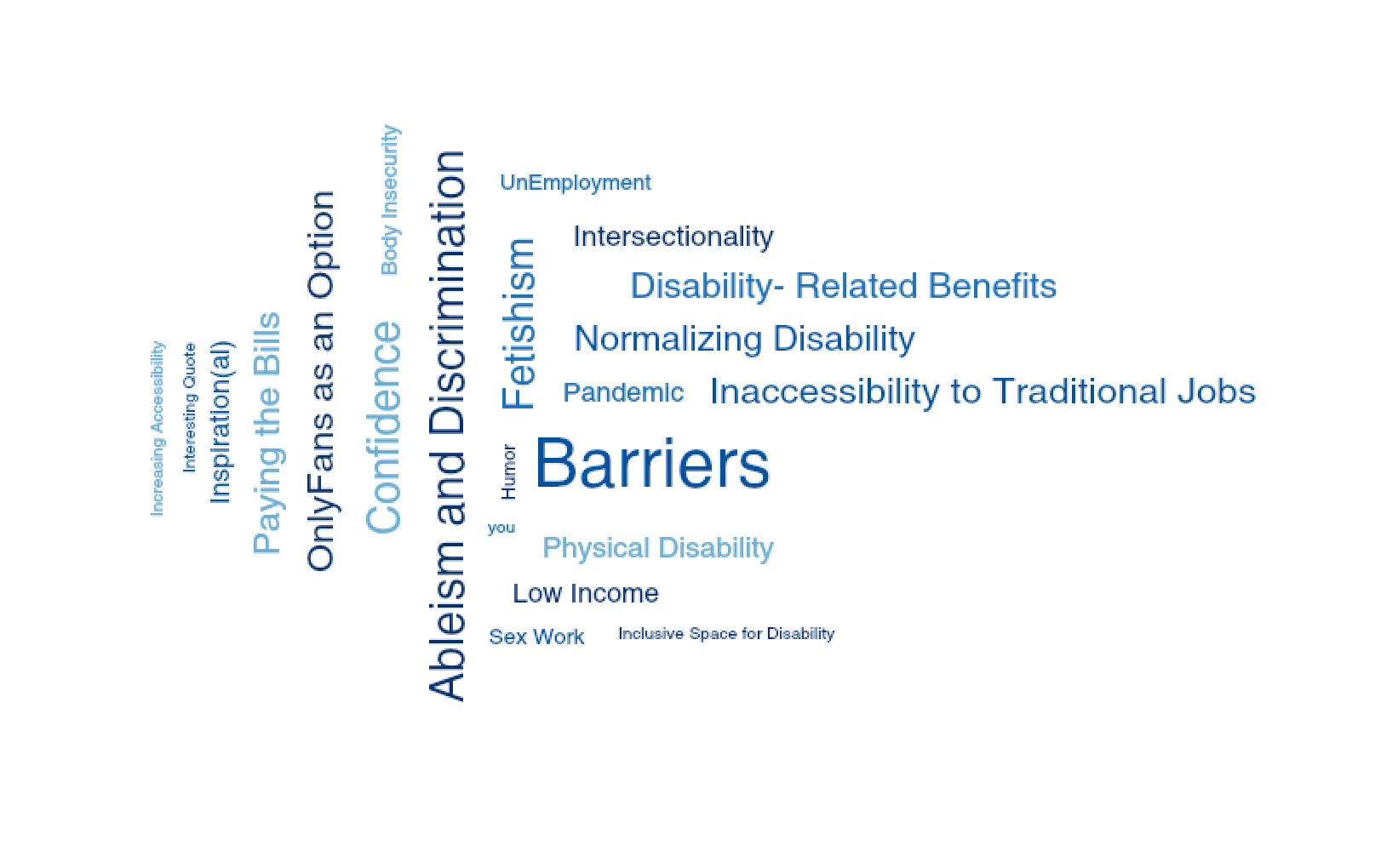
Across the news articles, a consistent narrative emerged: OnlyFans was often framed as one of the few forms of work that could accommodate disabled people’s lives. Traditional employment was described as inaccessible due to rigid schedules, physical demands, and unaccommodating workplaces. OnlyFans, by contrast, was portrayed as offering flexibility, autonomy, and bodily self-determination.
Importantly, these stories also highlighted how creators actively challenged dominant assumptions that disabled people are not—or should not be—sexual. Many spoke about expanding beauty standards, reclaiming desirability, and asserting sexual presence in spaces that routinely exclude disabled bodies. Ableism and harassment were still present, but these accounts often emphasized increased confidence and self-acceptance alongside vulnerability.
Reddit offered a far more behind-the-scenes perspective. Disabled creators discussed the constant negotiation between financial survival and fear of losing disability-related benefits, the physical and cognitive demands of platform verification processes, and the emotional labor of ongoing self-promotion and audience management.
One of the most striking findings concerned fetishization. While often framed exclusively as harm, some creators described selectively reclaiming fetishization: as a niche market, a strategic choice, or even a source of embodied affirmation. These accounts complicate simplified moral narratives and underscore the importance of listening to disabled people’s own interpretations of their experiences.
For many posters, OnlyFans was not just work. It was a rare space to express desire, build visibility, and reclaim sexual agency in a world that routinely denies disabled people access to these forms of intimacy.
One of the most meaningful aspects of this project was witnessing the intellectual and ethical growth of Eleni and Rachell. Their insights—particularly around representation, power, and online vulnerability—pushed our analysis in important directions.
In this sense, Dedoose served as both a research platform and a teaching space. The ability to:
meant that the platform supported not just analysis but also the formation of a research community. This aligns with my broader commitment to inclusive and community-engaged research practices that mentor the next generation of disability and sexuality scholars.
If you are approaching your first qualitative project in Dedoose:
This study contributes to a growing body of work that insists on centering disabled people within sexual cultures rather than treating them as peripheral or exceptional. Disabled creators on OnlyFans are expanding how we understand desirability, erotic labor, and agency, while exposing the structural constraints that continue to shape digital intimacy.
Using Dedoose allowed us to trace these complexities with care and precision. More importantly, it supported an analysis that respected the voices embedded in our data while critically engaging the systems that shape digital sexual labor. For our team, this project was not simply about studying a platform, it was an invitation to rethink what digital intimacy looks like when disability is placed at the center rather than the margins.


