


Read how Dr. Blackwell used Dedoose in her dissertation research!
Access resources tailored to your learning style
Getting Started with Dedoose
Review key features and terminology, data preparation tips, create a project and import data.
Learn More


Review key features and terminology, data preparation tips, create a project and import data.
Read how Dr. Blackwell used Dedoose in her dissertation research!
When I began my dissertation on how Black teacher candidates use culturally sustainable pedagogy (CSP) during Science of Reading (SoR) instruction, I knew I was stepping into an often untold story. My participants were Black teacher candidates working with Black elementary students during word study instruction. Their teaching was layered with identity, culture, relational warmth, structured literacy, and instinctive cultural intuition.
My data reflected that complexity. I had questionnaires, interviews, observations, coursework, and reflexive notes with each offering a different angle on how candidates understood CSP and how those understandings showed up in their instruction. It was rich and overwhelming. I needed a way to hold all of it at once. That’s where Dedoose became essential.
If you’re a qualitative researcher, a doctoral student, or someone curious about how digital tools support culturally grounded research, I hope this offers a window into what the process can actually look like.
My study centered on two questions:
“What are Black teacher candidates’ understandings of Culturally Sustaining Pedagogy?”
and
“How are Black teacher candidates’ CSP practices evident in their practicum experiences during word study instruction?”
These questions required me to look at beliefs and practice, and to understand how candidates navigated the tension between racial identity, institutional expectations, and structured literacy. I used Participatory Action Research as my methodology. That approach is not about studying participants but studying with participants. That meant I needed a tool that could hold multiple data types, allow me to code deductively and inductively, help me track patterns across participants, support memoing and reflexive thinking, and visualize themes as they emerged. Dedoose ended up being the right fit. I was grateful that my chair recommended it as a cost-effective option for my study.
My data sources included surveys to identify eligible candidates; observations of candidate’s word study instruction; interviews exploring beliefs, CSP understanding, and decision-making; coursework and reflections showing how they made sense of their students and themselves as learners and teachers. It was important for me to have a clear way to represent each piece of data and be able to make connections across sources and participants. Each source revealed something different. The interviews showed their beliefs. My observations showed their instincts. Their coursework showed their reflections. Dedoose allowed me to see how these pieces fit together.
One of the biggest challenges for me was allowing the data to “speak”. I was so intrigued as I began to see what seemed like trends across the sources. I had to take frequent breaks to walk away and practice reflexivity to ensure that the words and ideas were the participants' and not imposed by my personal interests and biases about the messages in the data sources.
Features like the word cloud and word frequency count helped me follow where the data was leading. I learned that the candidates were enacting CSP without naming it. They used warmth, shared colloquialisms, affirming language, movement-based learning, and cultural references, but they didn’t always recognize these as CSP practices. There was a gap between implicit practice and explicit knowledge.
In my research, I also found tension between racial identity and pedagogy. Candidates often relied on assumed cultural matching, the idea that shared racial identity automatically meant shared experience. This created uncertainty around dialect correction, representation, and authenticity. Dedoose features allowed me to see these ideas in the excerpts.
While there were challenges, the study's promises were undeniable. Candidates integrated structured literacy with culturally sustaining practices in ways that were instinctive and deeply relational. They used: chants, color-coding, movement, warmth and humor, personal disclosures, and culturally familiar encouragement. They centered their students’ identities as they taught foundational reading skills. Watching this unfold in the data was one of the most affirming parts of the research.
Below is the step-by-step process I used inside Dedoose, the part that researchers often don’t talk about publicly, but absolutely should.
I started with a small deductive codebook based on my survey and conceptual frameworks: Black teachers, Science of Reading, Culturally Responsive Teaching, and Black Gaze Framework. This gave me a foundation, but I suspected that the real story would emerge inductively as I engaged with the data.

I uploaded all my transcripts, observation notes, coursework excerpts, and survey responses. Dedoose allowed me to tag each document with relevant descriptors. This made comparisons much easier later. The ability to duplicate excerpts to link them to relevant codes supported the iterative process of code generation and reduction.
My analysis followed four rounds, which Dedoose supported.
Round 1: Descriptive Coding
I tagged what I saw: cultural references, instructional moves, relational moments. The word frequency count helped to confirm that I was maintaining alignment with what the participants were actually saying.
Round 2: Pattern-Focused Coding
Patterns began to emerge, such as: Multisensory engagement, empathy-driven relationships, and incidental cultural responsiveness. I used the excerpts and memos to begin capturing the emerging themes related to the various word patterns.
Round 3: Provisional Coding
I refined codes based on my frameworks and used Dedoose tools, such as memos and excerpts, to further align the data with the study's guiding frameworks. The ability to group memos and use color coding helped to structure my findings.
Round 4: Refinement & Merging
Some codes collapsed together; others split apart. Dedoose’s code frequency tools helped me see what mattered.
Memos were where I processed tensions, surprises, questions, bias checks, and connections to theory. They were used frequently, as PAR requires that participants and their experiences are always centered and not secondary to the investigator's research interests.
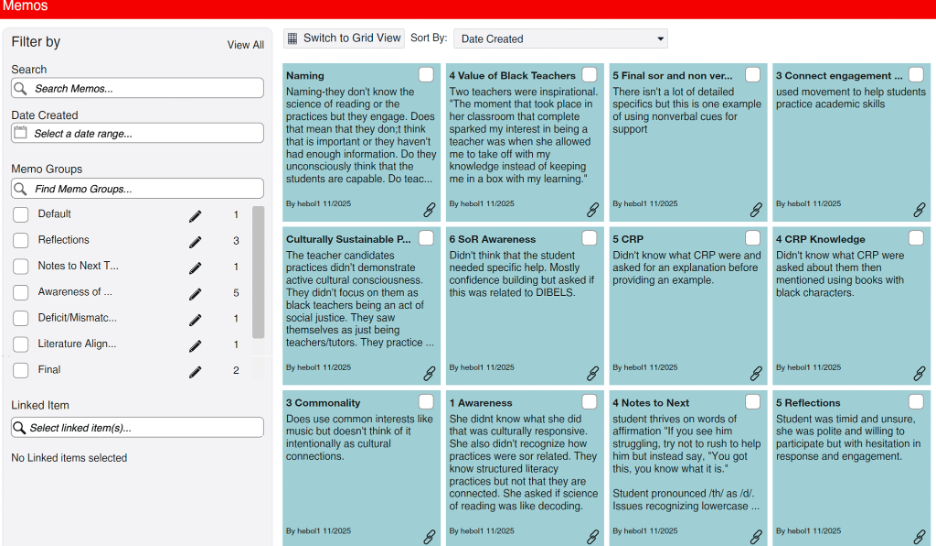
Dedoose made it easy to compare what candidates said in interviews, what they did in observations, and what they reflected on in coursework. This is where my findings were solidified, particularly as I explored the gap between implicit practice and explicit knowledge.
The code cloud and excerpt charts helped me see which themes were most prominent. These visuals helped me confirm that my findings were consistent across participants and data types.
If you’re new to Dedoose, here’s what I learned. Start small. Your codebook will grow, just let it. Use memos early and often; they truly become your analytic backbone. Expect your codes to evolve as you collect and analyze more data. My four rounds of coding were necessary. Return to your excerpts frequently. It keeps you grounded in participant voice. Let the data lead you. Your best findings will surprise you.
Using Dedoose didn’t just help me organize my data, it helped me see my participants more clearly. It helped me honor their voices, instincts, cultural intuition, and instructional decisions. Dedoose helped me move from raw transcripts to findings that reflect the depth of Black teacher candidates’ work with Black students. Most importantly, it helped me tell a story that needed to be told.
Heather Blackwell, PhD, is a literacy researcher and educator whose work sits at the intersection of identity, culture, and reading instruction. A proud graduate and faculty member of Morgan State University, Heather studies how Black teacher candidates make sense of the Science of Reading as they teach Black children, work that grew out of her own experiences as a Black literacy educator navigating systems that often overlook cultural knowledge.
As founder of Purposeful Literacy, LLC, she partners with schools, districts, and community organizations to design literacy experiences that honor students’ identities and strengthen instructional practice. Her work with the Maryland Institute for Literacy and Equity (MILE) focuses on building institutional frameworks that center culture, community partnership, and equity-driven literacy development.
Heather’s research, teaching, and consulting are all grounded in a simple belief: literacy is a justice issue, and children deserve instruction that sees them, affirms them, and prepares them to thrive.


