


A guide for choosing the best qualitative data analysis software
Access resources tailored to your learning style
Getting Started with Dedoose
Review key features and terminology, data preparation tips, create a project and import data.
Learn More


Review key features and terminology, data preparation tips, create a project and import data.

A guide for choosing the best qualitative data analysis software
Our team spends a lot of time thinking about the practical aspects of conducting rigorous qualitative and mixed methods research. There are hundreds of large and small analytical decisions that shape whether findings hold up to scrutiny and produce meaningful results. Part of that work means staying current with the tools researchers are using, understanding where those tools support good methodology, and being honest about where they don’t.
This evaluation grew out of that ongoing work. Scholars affiliated with the Institute for Mixed Methods Research (IMMR) evaluated nine widely used qualitative and mixed methods analysis platforms and scored each one across two primary dimensions: the breadth and depth of their analytical feature sets, and the quality of methodological expertise and support available to users throughout a research project. The goal wasn’t to produce a ranking for its own sake, but to give researchers a clearer picture of what they’re working with — and what they might be missing.
Regardless of the tools any investigator adopts and uses successfully, these insights can be used to improve how any tool for these types of investigation is used and how results can be effectively extracted, interpreted, and communicated.
Software comparisons commonly focus on surface-level features — interface design, pricing, integrations, and platform availability. While important for understanding adoption, this assessment does not evaluate whether a tool supports rigorous research practices. Accordingly, we focused here on two dimensions we think are more consequential.
Analytical feature depth refers to whether a tool’s capabilities match the demands of qualitative and mixed methods research as actually practiced by real researchers in real-world settings. Rigorous qualitative work often requires hierarchical coding structures, the ability to manage and compare multiple coders, tools for examining relationships between codes, and ways to visualize and interrogate patterns across subsets of data. Mixed methods research adds another layer: the ability to closely connect qualitative data and findings with quantitative data, run statistical analyses within the same environment, and support the kind of integrative reasoning that gives mixed methods its analytical power.
Methodological expertise and support refer to what happens when researchers hit a wall — and they always hit walls. The question isn’t whether you’ll need help, but what kind of help is available when you do. There’s a meaningful difference between a support team that can troubleshoot a software bug and a support team that can help you think through whether your analytical approach is appropriate for your epistemological commitments. Most tools and services offer the former. Very few offer the latter.
To contextualize Dedoose's positioning in the market, the Institute for Mixed Methods Research evaluated nine qualitative and mixed methods research tools across two dimensions: breadth of analytical features and depth of expertise and support. The table below presents the evaluation of nine tools across those dimensions, scored on a 0–10 scale, providing a baseline for understanding Dedoose's competitive differentiation that is detailed throughout this post.
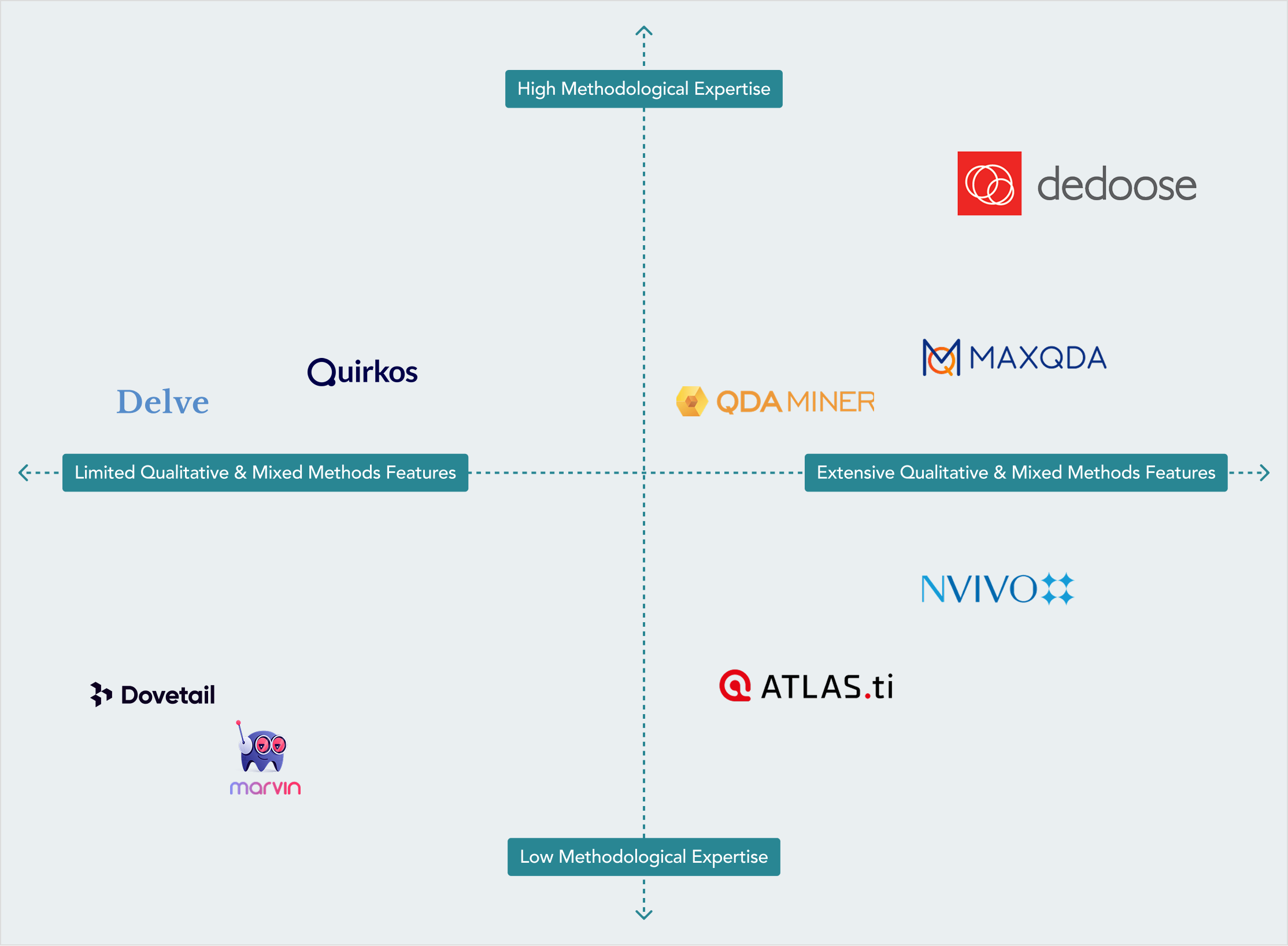
Interested in the scoring methodology developed by the Institute for Mixed Methods Research? Learn more by downloading the criteria here.
Dedoose’s feature score of 9 reflects a platform designed and built intentionally to support the full spectrum of qualitative and mixed methods research practice. On the qualitative side, it supports advanced coding schemes, hierarchical code structures, multi-coder environments with inter-rater reliability tools, complex filtering and retrieval across large datasets, and visualization of coding patterns and relationships. On the mixed methods side, it integrates statistical analysis — including ANOVA, t-tests, chi-square, and correlation — within the same environment as the qualitative analysis tools, and supports the linkage of qualitative data to quantitative variables and results.
This feature set was developed through the ongoing involvement of active social scientists in the platform’s architecture — the Dedoose founders are researchers who were working through the same practical and analytical problems that most researchers faced with the limitations of tools that existed at the time.
Dedoose operates on a subscription model, and every subscription tier includes the full feature set. There is no version of Dedoose where certain analytical capabilities are locked behind a higher pricing tier, and there is no separate charge for collaboration. What you pay for is access — and access means everything the platform offers, whether you are on a Mac, PC, or Linux computer, or switching between them.
That last point deserves emphasis. Because Dedoose is cloud-based, it is genuinely platform-agnostic. A researcher on a Mac, a Windows machine, or a Linux is experiencing the exact same tool with exactly the same capabilities. There is no Mac versus Windows feature disparity, no functionality that behaves differently depending on the operating system, and no need to verify platform compatibility before purchasing. Your data and your project live in the cloud, which means they’re accessible wherever you are — whether you’re working in your office, at a conference, in the field, or on a different computer than usual.
This is a meaningful practical contrast with NVivo, ATLAS.ti, and MAXQDA. All three have historically maintained different feature sets across operating systems, have different price points for the web vs desktop versions, and the Windows version typically offers more complete functionality than the Mac version. For individual researchers, this may be a manageable constraint. For teams working across different systems, it introduces a genuine inconsistency in the analytical environment — where what one team member can do depends on what computer they’re using. NVivo in particular has a long-documented record of feature gaps between its Windows and Mac versions that has frustrated research teams for years.
Every Dedoose subscription includes the complete feature set. No gated features. No collaboration add-ons. No platform-dependent gaps. The pricing model for NVivo, ATLAS.ti, andMAXQDA works differently — perpetual licenses carry substantial upfront costs, collaboration requires higher-tier subscriptions or separate licensing, and the true cost of using those tools for team research is consistently higher than the base price. Dedoose has all features included and collaboration standard at no additional cost, which is a more honest representation of the actual cost of your analysis when using these tools.
One thing that doesn’t come up often enough in tool selection conversations is that research careers, the questions you ask, theoretical frameworks you use, and research designs don’t remain stagnant. A graduate student who starts with a straightforward interview study may find themselves, a few years later, running a multi-site mixed methods evaluation with survey data, video footage, with a full research team. A researcher who begins using a qualitative tool for one project may need it to handle multimedia data, structured quantitative integration, or cross-study comparison the next time around. Choosing a tool that fits your current project but has no room to grow with you means making that decision again — with all the migration costs, learning curves, and workflow disruptions that come with it.
This is an underappreciated limitation of several tools in this evaluation. Tools like Quirkos and Delve are genuinely accessible entry points for qualitative work, but their ceilings are low. Researchers who start there and develop more complex analytical needs will outgrow them quickly. Even NVivo and ATLAS.ti, despite their feature depth on the qualitative side, present a ceiling for any collaborative work and those with mixed methods designs that become more integrative.
Dedoose was built to accommodate the full arc of that growth. A researcher can start with a small qualitative project — a handful of interviews, a focused codebook, a single coder — and use only those aspects of the platform. The same account and the same project architecture can expand later, without migration or restructuring, to accommodate multimedia data including audio and video, survey responses linked to qualitative interviews, statistical analysis integrated alongside thematic analysis, and a multi-member team coding in real time. The platform doesn’t require researchers at any stage to adopt different tools or another paid add-on when their work becomes more sophisticated - it grows with them.
This matters particularly for researchers early in their careers, who may not yet know the shape their future work will take. Starting with a tool that has room to grow is a different decision than starting with the tool that’s easiest to learn today but requires a transition later. It also matters for applied researchers whose project scope shifts with funding cycles, for faculty who work across different methodological traditions depending on the line of inquiry, and for anyone who has ever had to rebuild an analytical framework in a new environment mid-project because the original tool ran out of road.
Another capability that is not represented in most tool comparisons — perhaps because most tools handle it poorly, gate it behind higher pricing tiers, or don’t support it at all — is real-time collaboration.
The most effective qualitative and mixed methods research is rarely a solo endeavor. Multi-coder teams are the norm in rigorous qualitative work precisely because multiple interpretive perspectives are fundamental methodological strengths. Applied research teams span organizations, institutions, and global regions. Dissertation students work with faculty advisors who need to see how they’re structing their project. Cross-institutional studies and geographically distributed teams involve researchers who have no shared institutional infrastructure but need to work in the same analytical environment.
Dedoose was built around the assumption that great research is, and should be, collaborative. The platform is cloud-based by design, which means all collaborators — regardless of institution, location, or organization — are always working in the same live project. There is no version control problem, no file-sharing bottleneck, no “who has the current file” or “who last merged the project” ambiguity that anyone who has managed a shared NVivo or MAXQDA project will immediately recognize. With Dedoose, changes to a project are reflected in real time for everyone on the project due to the cloud-based design.
Collaboration in Dedoose is not a premium feature. It is not gated, not limited to a maximum number of users, and does not cost extra. There is no seat-based pricing that makes adding a collaborator a budget conversation. A project in Dedoose belongs to the research team working on it — adding a co-investigator, a research assistant, a community partner, or an external advisor requires no institutional affiliation check and no additional software set-up cost. The team size on a project is determined by your research needs.
This stands in direct contrast to how most competing tools handle collaboration. NVivo’s collaboration infrastructure requires server-based licensing or specific cloud tier subscriptions, and multi-user access for larger teams can quickly become cost prohibitive. MAXQDA’s collaboration features are functional but not real-time — teams typically work through synchronized exports rather than a shared live environment. ATLAS.ti has improved its cloud offering for their text-based analysis tool, but collaboration remains an add-on consideration rather than a foundational design principle. For tools like Quirkos or Delve, robust multi-user collaboration was simply not a design priority.
The practical consequence for research teams is not trivial. When collaboration requires institutional infrastructure, seat-based licensing, or file synchronization workflows, it introduces friction that shapes how teams work — often leading researchers to default to siloed individual analysis rather than integrated teamwork. Dedoose removes that friction entirely, which is a design choice that reflects a genuine understanding of how effective qualitative and mixed methods research is conducted.
This is where the distinction between Dedoose and every other tool in this evaluation is most concrete, and where the question of ‘who is actually behind the tool’ matters most.
Dedoose was founded by social scientists who ran into the same limitations in existing tools as their colleagues did, and decided to build the platform they needed. 20 years later, that founding orientation has never changed. The social scientists who run the company and serve our Dedoose users are not software executives who acquired a research tool or product managers who surveyed the academic market. They are researchers who understand, from direct experience, what rigorous qualitative and mixed methods practice requires.
This is meaningfully different from what most research software companies do. The typical approach is to hire consultants during a design phase, incorporate their feedback into a product roadmap, and then have engineers build for a general market. The result is software that can pass a features checklist but doesn’t reflect the texture of how research unfolds — the iterative nature of codebook development, the methodological decisions that arise mid-analysis, or the specific demands of generating sufficient evidence to defend an analytical framework to a skeptical reviewer. Dedoose was built by and is still run by people who have been in those situations, which is why the platform handles such challenges in uniquely informed ways.
The Dedoose support infrastructure reflects the same foundation. Our support team includes PhDs and trained methodologists — not a general customer service team that tells you to go elsewhere. When a Dedoose user contacts support with a methodological question, they are reaching someone with the background to engage with it directly. For Premium users on a Premier or Enterprise plan, this support extends to project-based consultation: the ability to work through a specific research design challenge, get feedback on an analytical approach, or address a methodological concern with someone who has the expertise and experience to respond substantively. That level of support is not typically available through a software subscription — it’s the kind of engagement that usually requires hiring a methodological consultant separately.
For training needs that go deeper — workshops, certification programs, and formal methodological instruction — Dedoose works with the Institute for Mixed Methods Research. IMMR’s training programs are developed and led by their own team of researchers and methodologists, and they bring a depth of expertise in mixed methods design that reflects their singular focus on the field. That relationship means Dedoose users have a path to top-level methodological expertise and training beyond what any software company would provide internally.
The free Dedoose Learning Center and webinar series on the event page are available to all, not just Dedoose users, and are developed with the same orientation — addressing methodological questions, not just software procedures, and grounded in actual research practice rather than generic instructional content.
With that baseline established, here is how the other tools in this evaluation measured — and where the gaps are most consequential for researchers choosing among them.
NVivo and ATLAS.ti tend to be the first tools graduate programs introduce to students, largely because of their institutional longevity and the volume of methodological literature that references them. That familiarity has real value — there’s a substantial body of published guidance on using both tools across different methodological traditions.
But familiarity shouldn’t be confused with effectiveness or comprehensiveness.
NVivo scores a 7 on features, which reflects a genuinely capable qualitative analysis environment. It handles complex coding structures, supports multiple data formats, and has reasonably sophisticated querying and visualization tools. Where it falls short is on quantitative integration and collaboration. Researchers doing mixed methods work often find themselves facing the cost of moving data in and out of NVivo to run analyses elsewhere, then manually reconciling qualitative and quantitative findings — a process that introduces both inefficiency and interpretive risk. The joint display and integration functionality required by serious mixed methods design is not an area where NVivo has focused development.
The support score of 3 reflects something many experienced NVivo users will recognize: when you run into trouble, you’re largely on your own. The documentation is extensive but oriented toward technical procedures rather than methodological guidance. Support response times are known to be slow, and there’s no plan type for the kind of substantive methodological consultation that complex research designs often require. If your question is “how do I perform this operation in the software?” NVivo’s documentation can usually get you there. If your question is “how should I structure this analytical phase given my theoretical framework?” you’ll need to look elsewhere.
ATLAS.ti presents a different profile. Its feature score of 5 reflects solid qualitative capabilities — it handles coding, retrieval, and network visualization competently, and its interface has become more polished in recent versions. The meaningful gap is in mixed methods functionality, which ATLAS.ti has not developed in any substantive way. For researchers whose designs require integrating qualitative and quantitative data within a single analytical framework, ATLAS.ti requires significant workarounds or the use of supplemental tools. Its support score of 4 reflects decent documentation and some paid training options, but like NVivo, there is no mechanism for accessing genuine methodological expertise through the platform itself. It should also be noted that both tools are now owned by the same parent company, and the support offerings may naturally merge over time.
There is also a practical pricing concern with both NVivo and ATLAS.ti that doesn’t get enough attention: the available feature sets are not fully consistent across operating systems. Researchers working on Mac versus Windows may find that certain capabilities behave differently or are unavailable entirely depending on their platform. For teams where members work across different systems — common in academic and applied research environments — this introduces an additional and rarely discussed barrier. Moreover, real-time collaboration, where it exists at all, is treated as a premium addition, rather than a standard part of the product, meaning so teams that need to work together find themselves needing to pay more for a capability that should be foundational.
MAXQDA is the strongest competitor in this evaluation and deserves honest recognition. Its feature score of 8 reflects a platform that has invested seriously in mixed methods capability. The ‘Analytics Pro’ version of the tool includes statistical functions — ANOVA, t-tests, correlations — alongside its qualitative tools, has strong visualization options including joint displays, and supports the data linkages required for mixed methods integration. Researchers who have used both MAXQDA and NVivo for mixed methods work often note that MAXQDA’s qualitative and quantitative analysis integration feels more structurally coherent, not bolted on as an afterthought.
The gap opens on the expertise and support dimension, where MAXQDA scores a 5. The training resources are solid — regular webinars, methodologically aware documentation, an active user community — but are limited by their primary orientation toward learning the software and not supporting the kinds of methodological decisions that shape a study’s rigor in real-world settings. The support team is technically competent, but the infrastructure isn’t structured around project-based consultation or the kind of ongoing methodological engagement that researchers navigating complex designs often need. This is less a concern for researchers already confident in their methodological skills and simply seeking to adopt software for executing their work. However, for researchers who are still working through design questions or anticipate methodological challenges along the way, these limitations are more consequential.
On pricing, MAXQDA is a perpetual license product at a price point that reflects its feature depth — which means an upfront cost that can be significant for individual researchers, graduate students, or small teams without institutional funding. Like NVivo and ATLAS.ti, collaboration is not included as standard and carries additional cost as well as additional restraints on the number of collaborators. The cross-platform experience is more consistent than NVivo’s, but researchers should still verify that the specific capabilities their design requires are available on their operating system before committing.
Quirkos scores a 4 on features and a 6 on expertise and support — essentially the inverse of the pattern seen in the larger tools — and that trade-off is worth further examination.
The support and documentation provided by Quirkos is genuinely sound and notably better than typically found from a tool at its feature level. Their blog and resource library are methodologically thoughtful, written by researchers who clearly understand qualitative research practice, and they address real questions researchers encounter rather than serving primarily as software tutorials. For a researcher doing focused qualitative work — interview analysis, document review — and who values having substantive guidance available, Quirkos can deliver real value.
The primary constraint with Quirkos is its analytical scope. Quirkos is designed for qualitative text coding and has not prioritized mixed methods integration. There’s no framework for linking qualitative findings to quantitative data, no statistical functionality, and limited support for the kinds of complex, multi-layered coding structures that more advanced qualitative approaches require. A researcher whose work stays comfortably within qualitative-only territory may find Quirkos serves them well. A researcher whose design evolves toward integration — as many do, particularly in applied research contexts — will need to expect the costs of migrating to a different tool.
These three tools share a profile: feature scores of 2, expertise scores between 2 and 5, and design philosophies oriented toward UX research and product teams rather than academic or applied social science. They’re built with tools for teams that need to synthesize user interviews quickly, tag feedback, and identify surface-level patterns to inform product decisions. That work is legitimate and valuable for limited scope of needs, but it operates under different standards and expectations than those demanded by peer-reviewed research or formal program evaluation.
Delve scores slightly higher on expertise, scoring a 5, because its support documentation is found to be well-written and reflects some genuine familiarity with research practice. But the overall feature set is simply not structured for many of the analytical demands researchers seek to address: no mixed methods integration, no multi-coder infrastructure with reliability tools, limited code management, and no statistical capability.
For researchers whose work must meet standards and expectations of dissertation committees, peer reviewers, IRBs, or funding agencies, none of these tools were designed to suffice. To be clear, this is a descriptive observation rather than criticism and they are effective in serving the needs of a different community. As such, researchers who find themselves drawn to these platforms because of their accessibility and clean interfaces should be aware about what they’re trading away in terms of analytical breadth and depth and the consequences for the ultimate impact of their findings.
A growing number of tools are positioning AI, in the form of large language models, as a primary feature — automated coding suggestions, AI-generated theme summaries, machine-assisted pattern identification. This development is worth thinking about carefully on many levels and thus was not included in the grading criteria. In today’s environment, particularly for non-academic users, there is a growing use of AI in analysis of text-based data where the goal is a vague representation of the data they have rather than true analysis.
However, there are substantial methodological and epistemological concerns worthy of straightforward attention. The interpretive work at the heart of qualitative research — making meaning from data in a theoretically grounded, epistemologically coherent, context-sensitive way — is inherently a human-driven endevour that cannot be automated without fundamentally changing the definition and expectations of qualitative research. The value proposition of qualitative inquiry is situated in the human researcher, with their defined positionality, the theoretical framework employed, and accountability to the people whose experiences are represented in the data. These human factors are a hallmark of how comprehensive and contextually responsive interpretive decisions are made and how evidence can be extracted and presented to support and defend those findings. When such work is delegated to a machine, even partially, any interpretation of results must acknowledge—and at best explain—how the process has changed and any subsequent knowledge claims that have been affected.
This methodological concern is significant and clear, but there is a second set of concerns regarding the safe use of AI that researchers need to be pondering—and we’d argue that they are not being raised with sufficient alarm.
Without exception, the protection of human-subjects' data is of fundamental importance to researchers around the world. Qualitative research typically involves sensitive data and can include interviews with vulnerable populations, personally identifiable information, protected health data, confidential organizational information, or the private experiences of individuals who consented to participate in a research study. Properly sanctioned and evaluated research programs seek formal consent from participants with the promise that the data they provide will be protected and used only for approved research purposes by approved members of the research team not to have their responses processed by any third-party AI system. When research routes data through an external AI provider, those data necessarily leave the researcher-controlled environment, and their subsequent protection relies on the agreement between the two companies. Whether those data are retained, used for model training, or accessible to the provider’s systems for other purposes are questions that must be answered and most tools currently using AI integrations do not provide sufficient detail or clarity to meet standard IRB-level scrutiny and expectations.
This is not a hypothetical concern. The major AI providers whose models are embedded in many of these tools — including OpenAI, Anthropic, Amazon, and Google — have each faced serious and documented scrutiny over their data practices, training data provenance, and the terms under which user data is processed and potentially retained. Many of the models underlying these tools were trained on data acquired under contested circumstances, raising unresolved questions about intellectual property and consent that the research community has not yet fully grappled with. Researchers who are working under IRB protocols, HIPAA requirements, or data use agreements with funding agencies should be specifically and formally asking where their data travel when using an AI-integrated analysis tool — and verifying that the answer is consistent with the terms of their research agreements.
Data security has been a foundational principle for Dedoose since the platform was built. The researchers who founded Dedoose understood that qualitative data is not generic and sterile information — it is often among the most sensitive material researchers gather, because it captures the words, experiences, and lives of real people who trust the research process. That understanding shapes decisions about the Dedoose architecture, data handling, and what features to build—and not build. It is why Dedoose will not integrate AI in ways that would route participant data through external model providers. This decision reflects more than caution for the sake of the product, but to protect the nature of rigorous and proven research methods and investigator obligations to research ethics.
The social science research field is still working through if LLMs have a place in social science, what responsible LLM integration would look like, and we think this is worthy of an open conversation. As such, we believe that any of today’s tools currently leading with AI as a selling point are not promoting its use with appropriate consideration on the seriousness of the impact to the field and the quality of research findings. Researchers deserve to know what they’re agreeing to when they use these features — and right now, in most cases, there are many important questions that remain unanswered.
Rather than a simple recommendation, here are the questions worth consideration:
Dedoose was built by researchers, for researchers. Rigorous research deserves purpose-built software, and that's what Dedoose delivers. Dedoose has always been about more than software; it is about supporting the researchers who ask hard questions, work with complex data, and pursue understanding in service of something larger. This evaluation reflects that same orientation — grounded in specific reasoning, honest about the competitive landscape, and focused on what genuinely matters for high-quality research practice. Social science research is important work, and the people doing it deserve tools built to support it with integrity.
Stay curious and good luck with your research!
The Dedoose Team


